
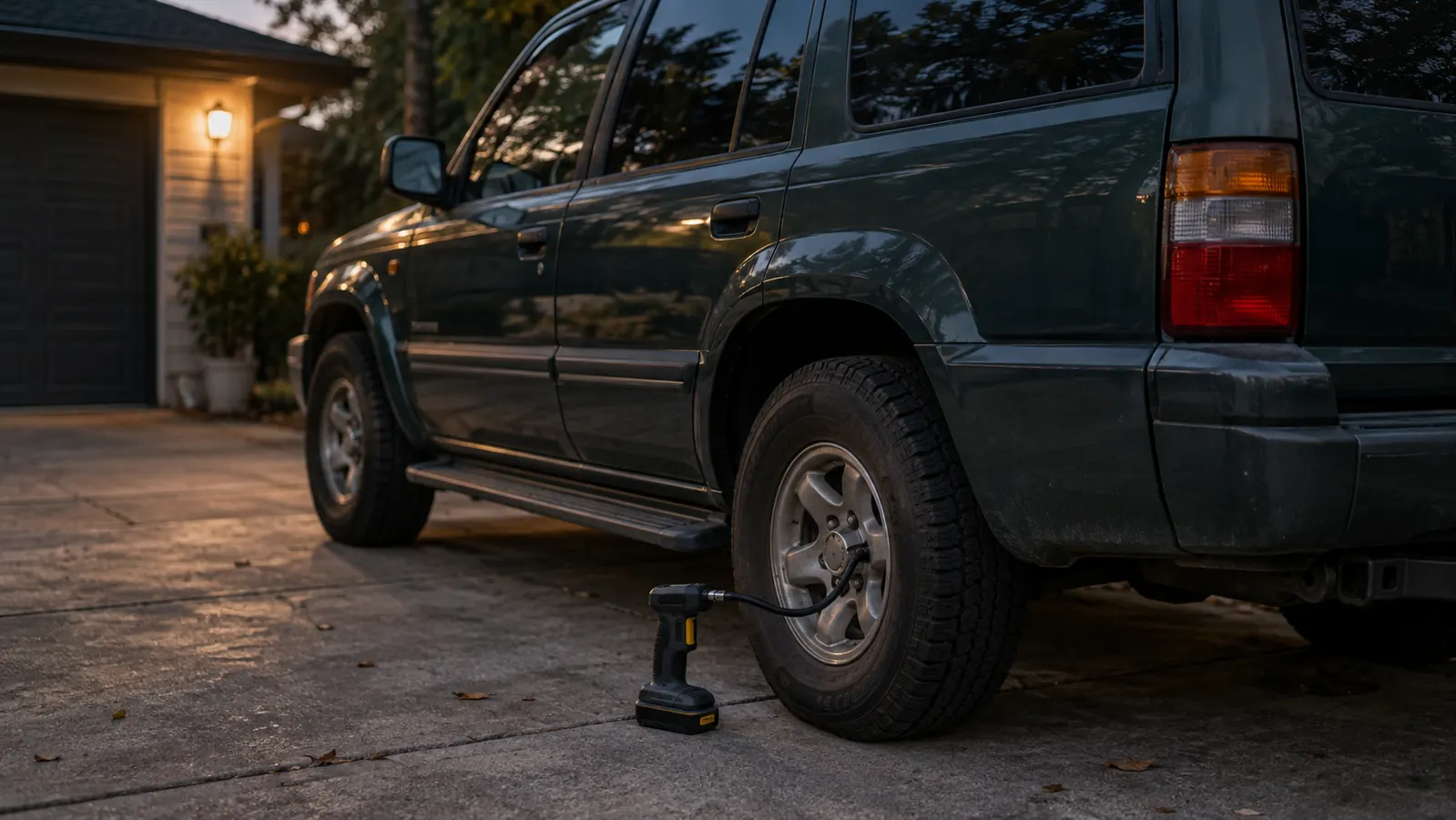
I'm Curt Ramsey, and I drive for a living. Most weekdays I cover the same seventy-mile stretch of US-65 out of Springfield, Missouri, in a 2016 Toyota Highlander with 191,000 miles on the odometer. In that car I have hauled sample cases, overnight bags, a spare battery, and more fast-food coffee cups than I should admit. Tire pressure is one of those things you stop noticing until it becomes the only thing you notice. Last year, near the end of a long sales day, the low-air warning light came on about ten minutes outside a small town, and I pulled into a station whose air hose wanted a card. The reader would not take my card. I stood there at dusk holding a hose that would not start, and I made a quiet decision: no more hunting for working air. That evening I ordered the AVID POWER cordless tire inflator.
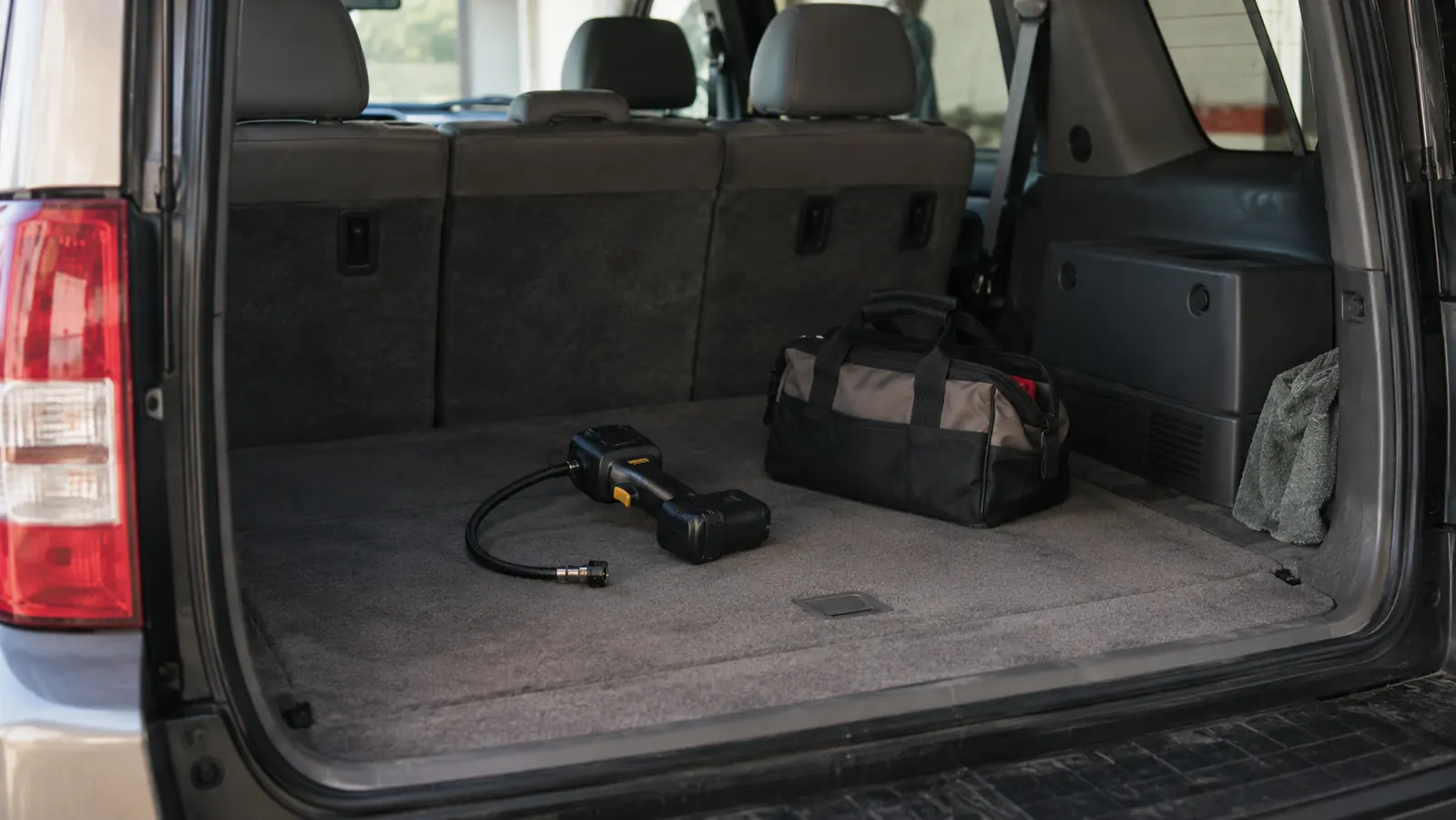
A year later, I can tell you exactly how that worked out. The AVID POWER pump is not a magic fix. It will not repair a cut tire, and it will not replace a shop compressor. It is a dependable rechargeable pump that has lived in the cargo area of the Highlander since the day it arrived, and I reach for it more often than I expected. I have used it on cold Sunday mornings, on a slow leak that lasted a week and a half, and once on the shoulder of US-65. I would buy it again. I keep it behind the second row, where I can reach it without moving anything, and I have not had a single morning where I wished I had left it in the garage. The rest of this review is the long answer, including the limitations you should know before you buy.
The Quick Verdict
A dependable cordless tire inflator that earns its place in the trunk. It stops at the pressure you set, handles slow leaks, and makes checking your own tires easy. Keep your expectations honest: it is a maintenance tool, not a rescue compressor.
Amazon Check Today's Price →End your search for working air
If you are tired of circling gas stations to find a hose that works, the AVID POWER inflator stops that pattern. It is rechargeable, it has an automatic pressure stop, and it tucks in the back. Check today's price on Amazon and read the current owner reviews.
Amazon Check Today's Price on Amazon →How I've Used It
My routine changed within the first week. I used to wait for the dashboard light, which in practice meant I drove around on tires that were already low. Now, every two or three weeks, usually on a Sunday, I pull out the inflator and check all four tires before the car has been driven, so the readings are cold and accurate. The sticker inside the driver's door calls for 35 psi in front and 33 in the rear, and I set the digital target on the pump rather than guessing.
The first real test came on a Sunday morning, and it sold me on the tool. The front passenger tire was at 29 psi, six pounds under the sticker. The car did not flash a warning, but the steering felt heavy and it drifted on the grooved asphalt. I set the inflator to 35, attached the hose, and let it run. It took about ninety seconds to go from 29 to 35, and it stopped on its own when it hit the target. I checked with another gauge: 35. No guessing, no overinflating, no trip to a station.
That pattern repeated all year. When a cold snap dropped every tire by two or three pounds, I topped them all off in the driveway in about ten minutes. When the left rear tire picked up a small nail and lost two pounds overnight, I gave it thirty seconds of air each morning for a week and a half. The leak never left me stranded, and I had the tire properly repaired when my schedule allowed. It is the kind of slow inconvenience that used to turn into an emergency, and this pump turned it back into an inconvenience.
Here is what that means in practice. I check tires now because checking tires is easy. Most of the time they are fine, but I know they are fine instead of hoping they are fine. When you drive 30,000 miles a year, the tires are one of the few parts you can actually manage day to day. One morning last fall, I found a tire three pounds low before a long trip. Ten minutes later it was back to pressure, the inflator was back in its spot, and I was on the road. In the old days, that tire would have stayed low until I hit a station I trusted. Having the numbers in front of me, and a way to act on them without leaving the driveway, is worth the space this pump takes in the cargo area.
The Digital Cutoff Earns Its Place
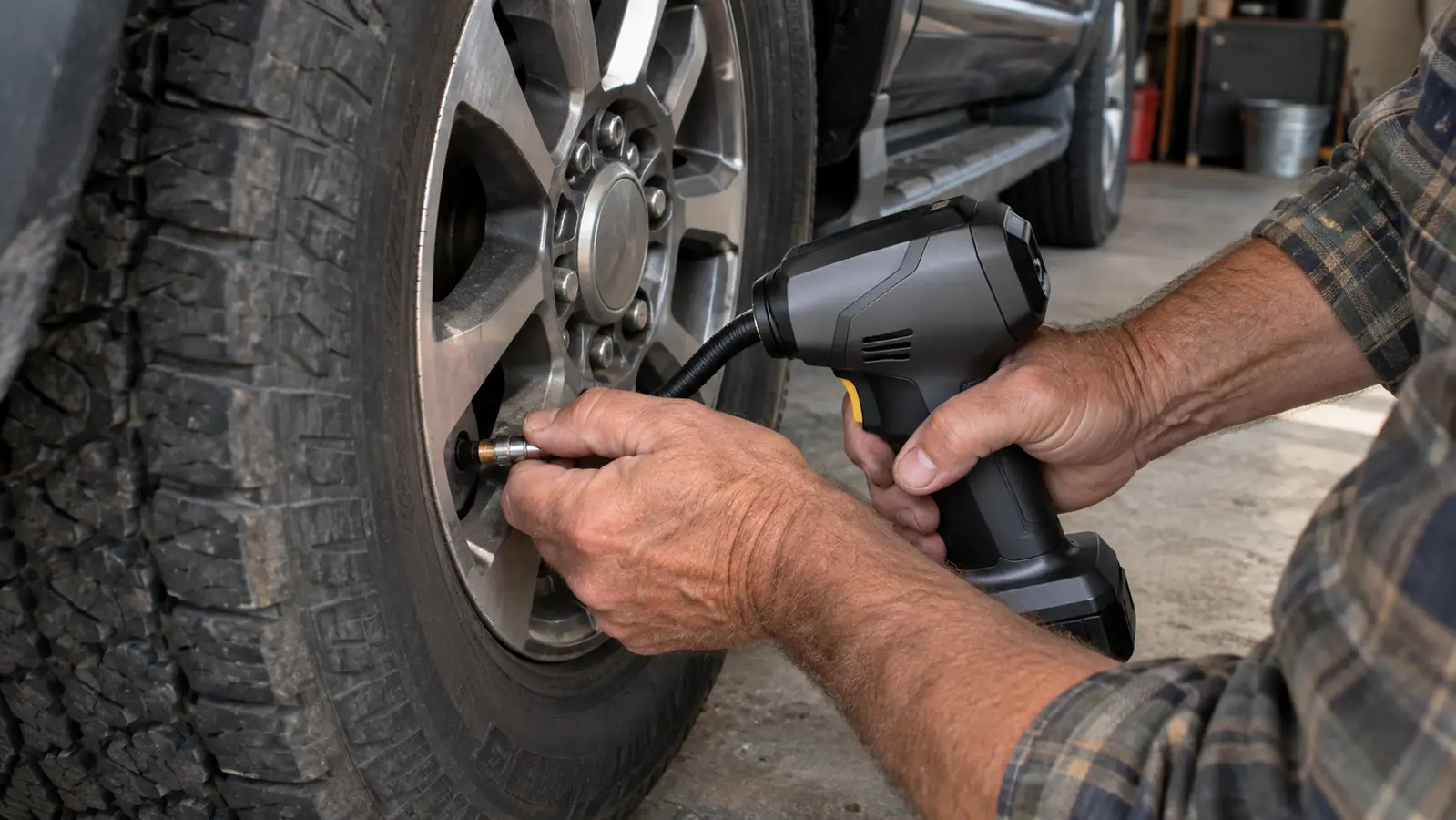
The feature that convinced me to buy this model was the automatic shutoff. I did not want a pump I had to watch with one hand on the trigger, because the moment I stop paying attention I will overinflate a tire. With the AVID POWER, you press the button until the screen shows the pressure you want, connect the hose, and let it run. When it reaches the target, it stops. It sounds basic, but after a year I can tell you it is the difference between a tool that gets used and a tool that stays in the garage. It is the kind of simple behavior that makes a tool feel fifteen years newer than it is.
I checked the readout against a separate analog gauge every time I filled tires for the first month. The numbers agreed within one psi, usually exactly. That may not impress someone who expects lab-grade equipment, but for tire maintenance it is all you need. It beats relying on a gas station gauge that has been rained on, baked, and dropped on the pavement for years. It does not drift over months, and I have come to trust it.
The other advantage is that you can start the pump and let it work while you walk around the car. By the time I have checked the other three tires, the first one is done. I have never had the pump overshoot the target, and I have never had to bleed air out of a tire because I overfilled it. That is the kind of quiet reliability I care about after twelve months of ownership.
The small screen is the weakest part of the system. It is readable, but in direct sun you have to shade it with your hand. That is a minor annoyance, not a reason to skip the tool. You will be holding the pump close to the valve stem anyway, so the shade is already there most of the time.
Gas Station Air Was My Last Resort
Before this pump, my tire pressure was set by whatever gas station I happened to pass, and I suspect that is where you are now. It starts with the hunt. There are stations with a hose that only takes coins, stations with a card reader that will not read, and stations where the hose barely reaches the rear tire of an SUV. Once you find a working hose, you are on a timer, and the gauge on the handle has usually seen better days. I have stood at those machines before and still finished with tires I did not trust. I do not miss any of it.
The AVID POWER has not made me swear off gas station hoses forever. I have used one twice this year while on the road and low on battery. Both times reminded me why I stopped. The hose was stiff, the gauge was optimistic, and I could not tell whether the rear tire had reached the target. It was not a nice way to spend ten minutes.
At home the contrast is complete. I can set the target pressure on the inflator, fill the tire, and put the tool back in the trunk. There is no running engine, no extension cord, and no line of other people waiting for the air hose.
Even with this tool I do not leave home with perfect pressures every single day. Tire pressure drops on its own over weeks, and temperatures change it faster than that. The pump does not change physics. It just makes responding to the physics a two-minute job instead of a twenty-minute errand. That is the real reason it has a permanent spot behind the second row.
The best thing the AVID POWER inflator does for me is not inflating tires. It is making me check them at all.
What It Will Not Do
Now for the honest part. The biggest limitation is that this is a top-off tool, not a rescue compressor. It will raise a low tire by several pounds quickly. It will also keep a slow leak driveable for days, as it did with my nail puncture. But if a tire is completely flat because of a cut or a hard impact, this pump cannot seal the hole. The air escapes as fast as the pump can push it. You need a spare or a service truck for a true flat. Know that boundary and the tool is exactly as advertised.
The second limitation is noise. There is no way to dress it up: the motor is loud. It sounds like a small shop vac. I would not use it in a quiet garage at six in the morning, and I usually wait until after coffee.
There are also little things. The screen washes out in bright light, so I shade it with my hand. The hose connector needs a firm push onto the valve stem, and if you release it too quickly you can lose half a pound of air. The battery charger is the kind you plug into the wall, so if I drain the battery on a Saturday, I recharge it overnight before it goes back in the car.
None of these flaws has changed my opinion. I bring them up because if you buy this tool expecting a garage-grade compressor, you will be disappointed. If you buy it expecting a convenient way to maintain your tires, you will get exactly what the package promises, and no more.
Battery Life After a Year
The pump uses a 20-volt battery pack and came with a single battery and charger. I do not own other AVID POWER tools, so I have to plan around that one battery. In practice it has not been a problem. A single charge has topped off all four tires twice and still had enough left for a short job a few days later. During normal use, I recharge about once a month, and after a year I have not noticed the runtime shrinking. The runtime feels honest, and the gauge does not lie.
Cold weather does slow it down a little, as it does with any lithium-ion tool. When the temperature is near freezing, the battery light drops faster than it does in July. I have never had it die in the middle of filling a tire, but I do not start a long trip with a low battery. I plug it in the night before, like I do with my phone and my work laptop. That consistency is worth a lot on a gray day at the end of a long week.
The only time I came close to running the battery dead was during the January cold snap. I filled four tires and then helped a neighbor top off two more. The battery still showed a charge when I was done, but I plugged it in that afternoon anyway. That kind of headroom gives me confidence that the tool will be ready the next time the pressure drops.
What I Liked
- Automatic shutoff at your target pressure, so no overinflating
- Cordless design means no 12-volt cord, no running engine, no outlet
- Small enough to stay in the cargo area all year
- Accurate enough to match a separate gauge within one psi
- Single charge covered my routine for weeks
Where It Falls Short
- Loud motor, so you will not want to use it in a quiet garage late at night
- Not for a truly flat tire with a sidewall cut
- Screen is hard to read in direct sun
- Only one battery included, so a spare means another purchase
Who This Is For
This is for a driver with an older car who treats maintenance as a conversation, not an emergency. If you are the kind of person who knows the recommended pressure on the door sticker and wants to actually match it, this tool will do that every time. If the words 'the air hose is around the back' make you groan because you have been through the runaround, you will understand why I keep this in the cargo area. It has earned its place in a vehicle that is approaching 200,000 miles and still needs to get me down the road every day.
The drivers who get the most use out of it are probably not the ones with a lift and a compressor in a home shop. They are more likely people like me: one car, one garage bay, a basic socket set, and fifteen minutes on a Sunday morning to make sure the car is ready for Monday. That is the exact situation this inflator was made for.
I realize I am describing a fairly narrow kind of satisfaction. It is the feeling of opening the back of your car, grabbing the inflator, setting 35, and hearing the motor stop a minute later. There is nothing glamorous about it, but there is something quietly reassuring about a tool that does the one job it has and does it well.
Before I ordered it, I assumed I would use the inflator twice a year. The actual number is closer to twice a month. That is not because I have bad tires; it is because the tool makes the check so easy that I no longer save it for a problem. I count that as a win.
Who Should Skip It
I would save my energy if you never check tire pressure unless the light is on. A tool in the trunk does not help if it never gets used. I would also skip it if a good shop with free air is on your daily commute, or if you already own a full-size air compressor and are willing to drag it out. And I would absolutely not buy it as the answer to a full blowout on the interstate. For a true flat, you need a spare and a safe place to change it, not a battery pump.
If you have made it this far in a long review about tire pressure, you are probably not the person I just described. You are the one who checks the tires, maybe not as often as you should, and you are ready to make the check easier. That is exactly who the AVID POWER pump was built for.
One more distinction. I am not telling you this pump will make your car drive like new or save you from every tire situation. I am telling you that it makes the boring weekly task of checking pressure easier, and that consistency has been worth more to me than any dramatic rescue. If you already have that habit, you know the value. If you do not have the habit, this tool is one of the easiest ways to start it.
A year later, it still rides in my cargo area
I ordered it one tired evening when a gas station card reader failed me. Twelve months later, it has topped off tires through a Missouri winter, kept a nail leak driveable, and never once sent me hunting for a working air hose. If that is the tool you want for your own car, check today's price on Amazon and read the current owner reviews before you decide.
Amazon Check Today's Price on Amazon →