
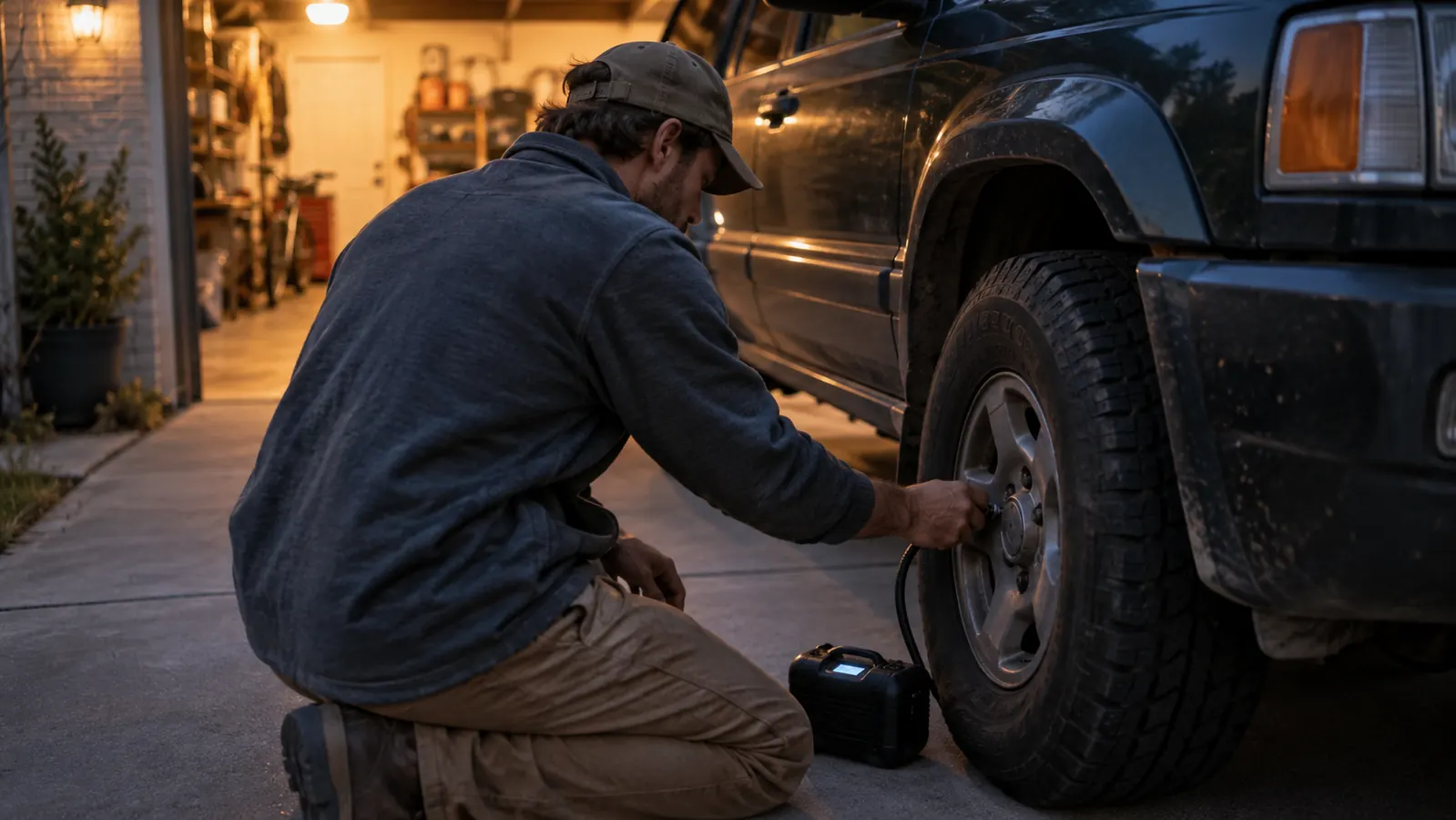
It was a Sunday morning in early August, and all four tires on my Highlander had drifted down to about 30 psi when the door sticker on the driver's side calls for 33. The gas station down the road takes coins and a slow walk around the car in the heat, so I grabbed the AVID POWER cordless inflator from behind the rear seat and topped them off in the driveway instead. The pump hummed, the numbers on the display climbed one psi at a time, and I was back inside before my coffee went cold. That first experience was a good one, and it almost kept me from writing the rest of this review.
This is the longer version of that story, the one the five-star reviews skip. The inflator has lived behind the rear seat of my Highlander since last April, and eight months and roughly 18,000 miles of Missouri driving later, what I have learned is more useful than anything I read before I bought it. The AVID POWER inflator is a genuinely handy tool, and I would buy it again. It is also slower than the listings imply, its built-in gauge reads about two psi high on my unit, and the battery needs more planning than the box suggests. None of that is a reason to skip it. All of it is a reason to buy it knowing what it really is.
The Quick Verdict
An honest tool for an honest job. It tops off tires, fits behind the rear seat, and handled one real roadside slow leak without drama. But the gauge lies a little, the battery recharges slowly, and a truly flat tire is more than it wants to do. I keep mine in the car and I would buy it again.
Amazon Check Today's Price →The cordless tire inflator that has lived in my car for eight months
If you are tired of hunting for coins and checking pressures only when you happen to be near a working air pump, the AVID POWER inflator puts the job back in your own driveway. Battery life is honest for topping off four tires, the case is small enough to live behind the rear seat, the built-in light helps at night, and the only habit you need is double-checking the final number with a separate gauge.
Amazon Check Today's Price on Amazon →How I've Used It
The inflator has lived behind the rear seat of my 2016 Highlander since last April, which is the only place it could live and still be useful. I drive the same 70-mile stretch of US-65 most weekdays for my sales route, and with 191,000 miles on the odometer, this car loses tire pressure faster than it did when it was new. Every other Sunday I check all four tires in the garage with a separate pen gauge before I wash the car or do anything else to it. When one reads low, I grab the AVID POWER unit from behind the seat and fix it in the driveway instead of making a trip into town.
Most of my use is deliberately boring, and boring is the point. In mid-October the overnight temperature dropped from the mid-60s to the mid-30s over a single weekend, and every tire lost about three psi. The TPMS warning for the right rear came on somewhere north of Fair Grove on a Thursday morning, and by the time I found a safe shoulder the display showed 29 psi on that corner. I took the inflator out, set the target two psi high the way I will explain in a minute, and had all four tires back to the door sticker number in about twelve minutes. That is the use case that matters to a driver, not the dramatic full-flat photos in the listing.
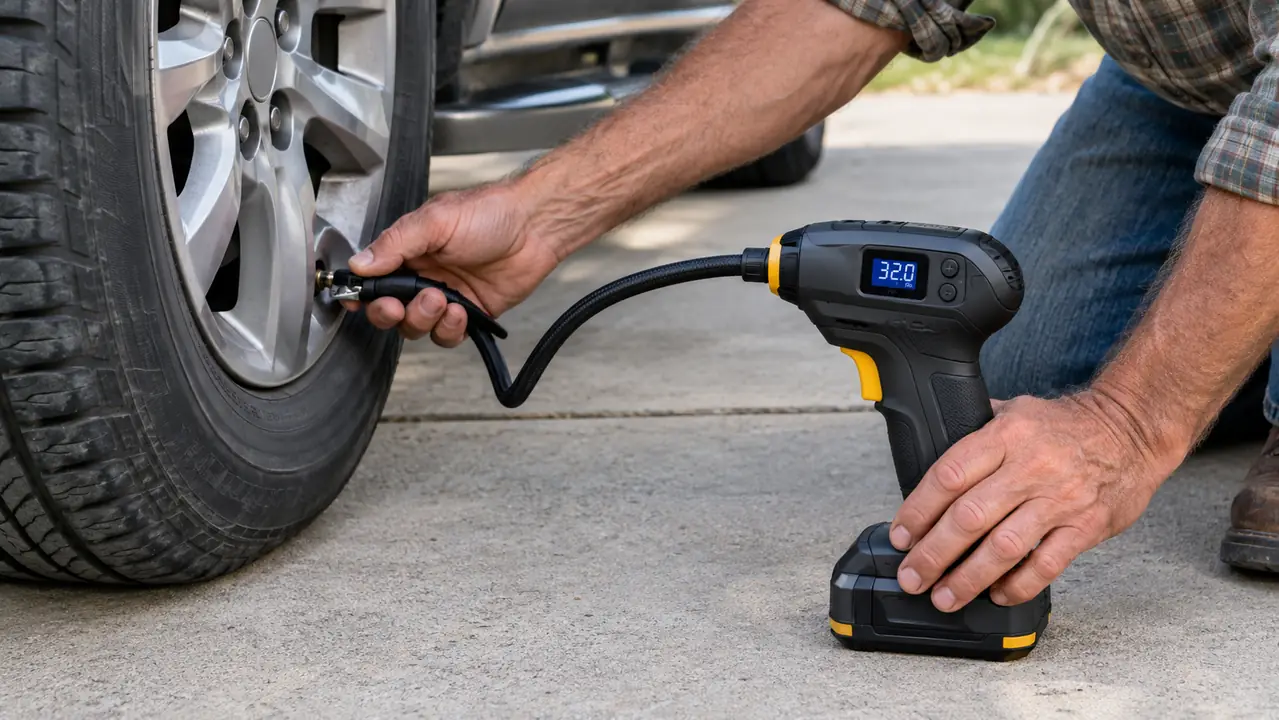
A single tire that is four psi low takes about ninety seconds from the moment the hose reaches the valve stem to the moment the pump stops. The motor makes a steady whine, and the whole body vibrates enough that I set it on the ground rather than holding it against the tire. After a full four-tire session in the driveway, the battery indicator on mine still showed two of three bars. That has been consistent for eight months, and it tells you something important: this battery is sized for keeping tires healthy, not for rescuing a completely flat one.
What Nobody Tells You About the Battery Life
Here is what I did not understand until I needed it: a 20V battery is excellent for a tire that already has 27 psi in it and only needs to reach 33. It is only fair for a tire that is completely flat. My one real roadside rescue, in late October, was not the dramatic scene the product photos suggest. The right rear tire had picked up a screw somewhere on my route and sat at 16 psi when I checked it in a customer's parking lot in Bolivar. I screwed the hose on, set the target, and let the little pump run while I watched the display climb. It took about seven minutes to reach 32 psi. I drove twenty uneventful miles to a tire shop the next morning, and the tech found the screw in under five minutes. For that job, the inflator was exactly the right tool.
The same battery is the weak point in a Missouri summer. In July that car bakes in parking lots for nine hours at a stretch, and the inside of a closed SUV gets hot enough that lithium batteries do not enjoy it. I read more than one owner complaint about batteries that stopped holding a charge after a summer in a hot trunk, so starting in June I brought the battery inside on the hottest weeks and left the inflator body in the car. I cannot prove the heat would have killed mine, and I did not want to test it on a tool I depend on. That is exactly the kind of habit the reviews leave out.
Recharging is the other patience test. The battery takes the better part of four hours on the small wall charger that came in the box. That is fine on a Sunday afternoon and not fine if you drain the battery in the morning and need the pump again before dinner. I learned to charge it the night before a long trip, the same way I charge my phone, and I have never been caught empty. Plan for it and the battery is a non-issue. Ignore it and it will fail you at the worst time.
The Gauge, and Why I Set It Two Psi High
Now we get to the part that honest reviews are for. The built-in gauge on my unit reads about two psi high compared with my separate pen gauge, and it has read that way since the first use. The first time I filled a tire, I stopped when the display read 33 and then checked with the pen gauge: 31. On a car that carries 33 on the door sticker, two psi is the difference between a tire that wears evenly and a tire that wears its shoulders early. It is also the difference between a TPMS light that stays off and one that nags you at mile 40 of a 70-mile drive.
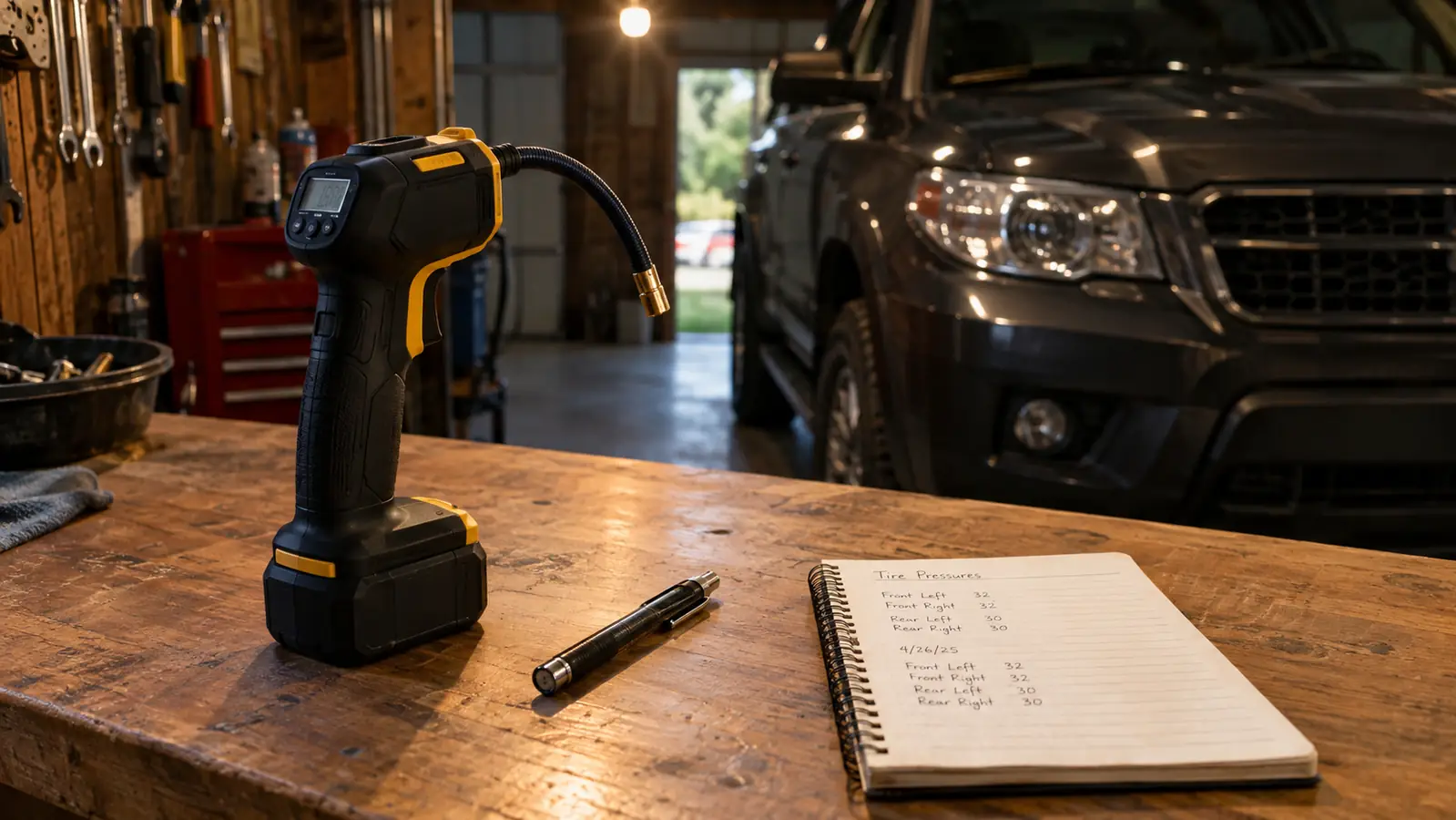
I tested this before I trusted it, because trusting a gauge that might be wrong is how you wear out a set of tires. One Saturday in September I aired the left front to exactly 33 on the inflator's display, drove six miles to the gas station with the calibrated air pump, and their gauge read 32. I repeated the test on the right front and got the same result. Over the next month I wrote down the readings in the little notebook I keep in the glove box: the inflator's display ran one and a half to two psi high every single time. From then on I set the target two psi above the door sticker and let the auto-stop do its job, then checked each tire with the pen gauge before putting the hose away.
I do not think this makes the AVID POWER a bad product, and I want to be clear about that. Every digital gauge in this price range reads a little differently from every other one, and the pen gauge I trust came from the auto parts store and has agreed with the gas station gauge for three years. The lesson is the habit, not the hardware: use the same gauge for every tire every time, and treat the built-in display as a guide until you have proved what it does against something you trust.
Where It Falls Short
Slower than a corded inflator is the honest headline, and nobody tells you that in the reviews because nobody times it. That late-October roadside rescue took about seven minutes to move the right rear from 16 psi to 32 psi, and the body of the pump was noticeably warm when the motor stopped. On a fully flat tire you can plan on longer than that and a battery that is mostly empty when you finish. I timed a test fill on a spare tire in the garage one Saturday: from 10 psi to 33 took six minutes and forty seconds, and the battery indicator dropped from three bars to one. The inflator did the job. It just did it slowly.
The little LED work light built into the bottom of the unit earns its keep, which is the one thing every review gets right. My October rescue happened in a dark parking lot at the end of a gray day, and the light pointed straight at the valve stem while the pump ran. I did not hold a phone in my teeth and I did not guess at the threads. That is a small thing until it is the difference between a clean connection and cross-threading the chuck on a cold evening.
The accessories are fine and forgettable. The kit comes with a few nozzle adapters in a small pocket of the thin carry bag, and I have used exactly two of them in eight months, once for a basketball and once for an air mattress on a trip. The bag lives loose behind my rear seat and takes the bumps without complaint. None of this changes my recommendation. It just means you should buy the AVID POWER inflator as what it is: a practical tool with practical limits, not shop equipment.
Alternatives I Considered and Why I Kept This One
Before I settled on keeping the AVID POWER in the car, I compared it with the two options most drivers actually have. The first was my old corded 12V compressor, which still lives on a shelf in the garage. It is faster, never needs a charge, and has a longer hose, but it only works within reach of the car, the cord has to run through the door or the window, and it refuses to fit anywhere in the cabin when I close the hatch. It is the right tool for the garage and the wrong tool for the side of the road, and I have owned both long enough to know which one I reach for.
The second alternative is the one most of us use by default: the air pump at the gas station. When it works, it is faster than any portable inflator. When it does not work, the hose leaks at the chuck, the gauge is worse than the one on this unit, and you have already fed it your change by the time you find out. In the winter I caught myself putting off pressure checks because it meant a ten-minute drive into town in the cold. That delay is exactly how tires wear out early and how a slow leak becomes a roadside failure. Having a cordless inflator at home means I check pressures when they are low, not when I happen to be near a working air pump.
What I Liked
- Battery handles four tires of topping off with charge to spare
- Small and light enough to live behind the rear seat, so it is there when needed
- The built-in LED light makes dark parking lots and shoulders manageable
- Auto-stop works once you learn your unit runs two psi high
Where It Falls Short
- Built-in gauge reads high, so you need a separate gauge to trust the final number
- Recharging takes hours, making this a plan-ahead tool
- Slower than a corded compressor on a truly flat tire
- The battery should come inside during a Missouri summer
I have topped off all four tires a dozen times on the same battery, and eight months in, it still holds a full charge.
Who This Is For
This inflator is for the driver who checks tire pressure at home, hates feeding coins to a gas station pump, and wants a tool that stays in the car so it is actually there when the temperature drops thirty degrees overnight and every tire loses three psi by morning. It is for the person who will set the dial two psi high and double-check with a separate gauge because they want tires that wear evenly and a car that does not leave them on a shoulder with a slow leak at dusk. It is for someone like me, who drives enough miles each year that a gadget like this earns its keep by the second month. If that sounds like you, this is a worthwhile buy.
Who Should Skip It
Skip this one if you expect a cordless inflator to be an emergency tool for a fully flat tire, because on an empty tire you will wait several minutes and drain most of the battery for a single wheel, and on a cold night that is exactly when you least want to wait. Skip it if you will not double-check the built-in gauge, because you will run your tires two psi low and wonder why the shoulders wear funny. And if you regularly maintain a trailer, an RV, or a heavy truck, buy a compressor that plugs into the wall or the 12V socket and skip the cordless class altogether. Cordless inflators are a convenience for cars. They are not a duty tool.
I keep coming back to the same bottom line, so I will leave you with it. The AVID POWER inflator has done everything I asked of it for eight months, and the only complaints I have are the two I warned you about: the gauge and the recharge time. Know both going in, set the dial accordingly, and this little pump will earn its spot behind your rear seat the way it earned mine. That is the honest version, and it is the one I wish I had read before I bought it.
The honest bottom line after eight months of daily carry
The AVID POWER inflator is the right tool for keeping your tires honest in the driveway and handling a slow leak on the road, as long as you set the dial two psi high and confirm the final number with your own gauge. It is not a shop compressor. Bought for what it actually is, it earns its space behind the rear seat.
Amazon Check Today's Price on Amazon →